
Most traders ask the wrong question.
They ask, “Did this trade work?”
What they should be asking is, “What did this trade teach me?”
Learning in trading doesn’t come from avoiding losses or celebrating wins.
It comes from systematic iteration — using outcomes as feedback to build a system that fits you.
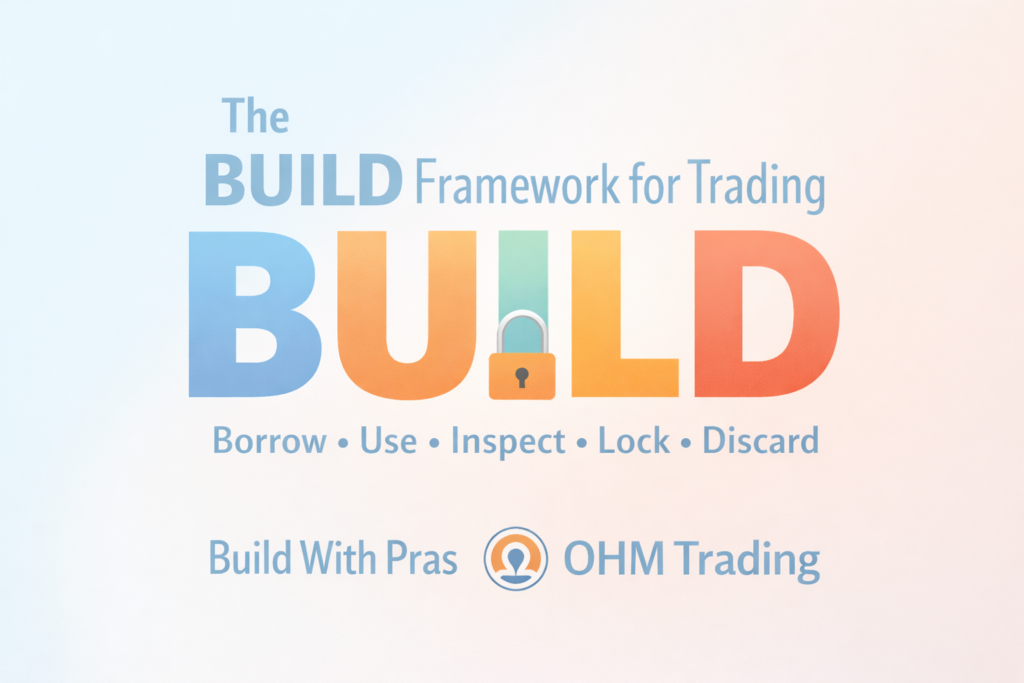
That’s where the BUILD framework comes in.
B — Borrow: Start on the Shoulders of Giants
“If I have seen further, it is by standing on the shoulders of giants.” — Isaac Newton
No trader starts from zero.
And the ones who try to usually pay the most tuition.
Borrowing doesn’t mean copying blindly.
It means starting with proven structures instead of reinventing the wheel.
Most successful traders begin by borrowing:
- Entry and exit logic
- Risk management principles
- Market structure frameworks
What they don’t borrow is identity — temperament, position sizing comfort, or decision speed.
In my own journey, I borrowed swing trading principles from multiple proven traders. But the goal was never to become them. The goal was to learn faster by starting from what already worked.
Borrowing shortens the learning curve.
Execution personalizes it.
U — Use: Let Reality Do the Teaching
A system that works on paper means nothing.
Behavioral finance shows us something critical:
Loss aversion and emotional bias only appear during real execution.
Until real capital is at risk, you’re not learning — you’re rehearsing.
Using a system means:
- Trading it as-is
- Not tweaking mid-trade
- Letting discomfort, hesitation, and confidence surface naturally
This phase reveals truths no backtest can:
- Can you hold through volatility?
- Do you interfere with winners?
- Does this approach drain or energize you?
Markets don’t reward theory.
They reward executability.
I — Inspect: Separate Signal From Noise
This is where most traders fail — and where all real learning happens.
Inspection is not emotional review.
It’s structured diagnosis.
Inspecting Losses: Correction Mode
“Every loss contains information, if you’re willing to look.” — Paul Tudor Jones (paraphrased)
A loss is not a verdict.
It’s a classification problem.
Every losing trade usually fits into one of three buckets:
- Wrong Entry
Poor location, chasing, bad timing. - Wrong Analysis
Structure misread, trend assumption wrong, base quality weak. - Wrong Market Environment
Choppy regime, distribution phase, risk-off tape.
Notice what’s missing:
- No blame
- No strategy hopping
- No emotional labeling
Losses are not meant to make you quit.
They’re meant to make you adjust precisely.
Inspecting Wins: Extraction Mode
Wins are more dangerous than losses if you don’t study them.
Pattern recognition research shows:
Experts don’t remember outcomes. They remember conditions.
A win should answer three questions:
- What conditions repeated?
Market phase, volume behavior, sector strength. - How did the trade feel?
Comfort matters. Calm execution is not weakness — it’s signal. - What process made this repeatable?
Entry logic, risk sizing, holding rules.
A win is not proof of skill.
It’s raw material for process design.
L — Lock: Turn Insight Into Structure
“What gets standardized gets repeated.” — Operations management principle
If something works more than twice, it deserves a rule.
Locking means:
- Writing it down
- Turning it into a checklist or constraint
- Removing discretion where possible
This is how intuition becomes process.
Locked rules:
- Reduce decision fatigue
- Prevent emotional overrides
- Create consistency under pressure
Trading freedom doesn’t come from flexibility.
It comes from structure you trust.
D — Discard: Improve by Removing
Lean thinking teaches a simple but powerful idea:
Continuous removal of waste improves system robustness.
Discarding is not admitting failure.
It’s maintaining system health.
You discard:
- Setups that repeatedly cause stress
- Rules that work for others but not for you
- Complexity without clear edge
A system doesn’t break because it’s missing rules.
It breaks because it has too many.
Simplicity is not minimalism.
It’s clarity earned through experience.
BUILD Is a Loop, Not a Destination
The mistake traders make is searching for the system.
The reality is:
- You build one
- Through borrowing
- Through execution
- Through inspection
- Through locking
- Through discarding
Then you repeat.
The same framework applies beyond trading — business, learning, decision-making, life systems. Because it’s not about markets.
It’s about how humans learn under uncertainty.
Final Thought
Wins don’t validate you.
Losses don’t invalidate you.
Together, they shape you — if you have a framework to learn from them.
That framework is BUILD – Build, Use, Inspect, Lock, Discard
Not faster.
Not louder.
Just better — one iteration at a time.
