
Most traders are drawn to excitement.
Wide-range candles.
News-driven spikes.
Stocks moving 8–10% in a single session.
They look powerful. They feel actionable.
But over time, I’ve learned that excitement in price is usually the worst place to enter risk.
That’s why I prefer boring bases over exciting breakouts.
Not because they are glamorous—but because they are honest.
The Seduction of Breakouts
Breakouts appeal to our instincts.
- Strong candles feel like confirmation
- Momentum creates urgency
- Everyone seems to notice the move at the same time
But that same visibility is also the problem.
By the time a breakout looks exciting:
- Early participants are already positioned
- Late entrants are chasing strength
- Risk expands faster than clarity
Most breakout failures don’t fail because the idea was wrong.
They fail because the entry demanded perfection.
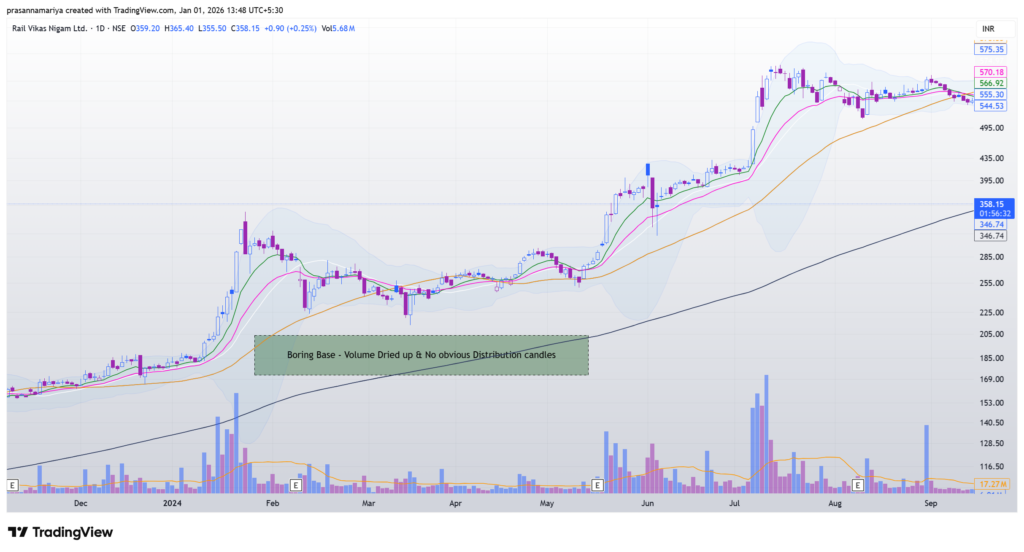
What a “Boring Base” Really Represents
A boring base is not inactivity.
It’s quiet preparation.
Price moves sideways.
Volume dries up.
Volatility contracts.
Nothing interesting seems to be happening.
And that’s exactly why it matters.
A base represents:
- Supply being absorbed
- Weak hands exiting quietly
- Strong hands holding without urgency
No urgency.
No emotion.
No public attention.
Just structure.
Why Boring Bases Are Easier to Trade
From a process perspective, bases offer advantages that breakouts rarely do.
1. Clear Risk Definition
A base gives you obvious invalidation.
If price breaks below the structure, the idea is wrong—cleanly.
2. Lower Emotional Load
There’s no rush.
No need to chase.
You can plan entries calmly and execute without adrenaline.
3. Better Asymmetry
When a stock moves after a base,
the expansion tends to be sustained—not frantic.
4. Institutional Footprints Are Quieter
Large players don’t advertise accumulation.
They operate during boredom, not excitement.
Excitement Usually Means Information Is Already Priced In
When something feels obvious, it often is—to everyone.
Excitement signals:
- Crowded attention
- Short-term traders competing for the same move
- Higher probability of shakeouts
Boring bases, on the other hand, don’t invite crowds.
They invite patience.
And patience compounds better than excitement ever will.
My Shift as a Trader
Earlier in my journey, I chased movement.
I wanted to feel involved.
I wanted action.
But my results improved only after I asked a different question:
“Where can I place risk with the least amount of decision pressure?”
The answer kept pointing back to boring bases.
Less noise.
Fewer decisions.
More consistency.
The Real Edge Isn’t Speed — It’s Structure
Trading doesn’t reward excitement.
It rewards alignment—between structure, risk, and behavior.
Boring bases force you to:
- Wait
- Plan
- Respect levels
- Accept delayed gratification
And those traits translate far beyond trading.
Final Thought
Exciting breakouts make great screenshots.
Boring bases build durable equity curves.
I’m not trying to be entertained by the market.
I’m trying to work with it—quietly, patiently, and repeatedly.
That’s why I choose boring bases.
Every time.
